
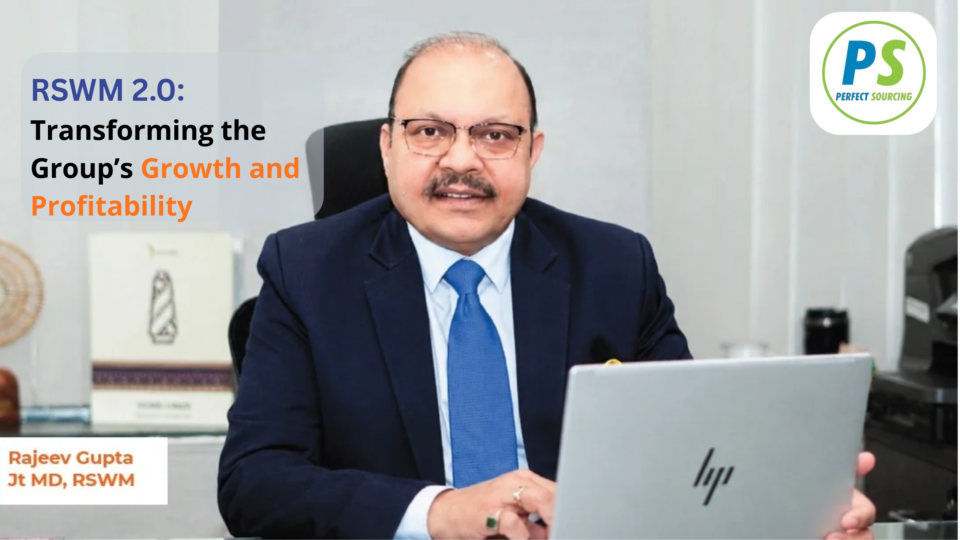
What does it take to turn around profitability while preparing for the next era of textile manufacturing? In a Face-to-Face conversation with dynamic and visionary leader Rajeev Gupta, JT MD, RSWM Ltd., a LNJ Bhilwara Group, TEAM PERFECT SOURCING gets some exclusive insights about RSWM 2.0 transformation which is reshaping its growth agenda—from sharper capital allocation and value-added textiles to circular manufacturing and AI-enabled garmenting. With FY26 marking a decisive return to profit, Gupta shares his vision for building a leaner, greener and globally competitive RSWM.
EXCERPTS
PS: Ever since you took over as the Joint Managing Director, what have been the most crucial decisions you have taken, and how have they helped the company in terms of revenue, profitability, and increased market share?
Rajeev Gupta: When I look at the journey of RSWM over the last few years, the focus has been on building a stronger, more agile and more profitable organisation rather than pursuing revenue growth at any cost. One of the most important steps in this direction has been the RSWM 2.0 transformation programme, built around the four pillars of People, Process, Planet and Profit. The objective is to improve operational efficiency, strengthen our value-added product portfolio, enhance sustainability and improve profitability. We have also introduced COCICA and RAPIDD as our Values & Competency frameworks, strengthening a culture of customer centricity, ownership, agility, collaboration and performance across RSWM.
We have also taken a conscious approach towards product mix and capital allocation. Rather than focusing only on volumes, we have rationalised products that were not generating adequate returns and concentrated on profitable revenues. This discipline has helped us improve our margins significantly. For us, Profit First means prioritising profitable revenues, operational efficiency and responsible capital allocation rather than pursuing growth purely through volumes.
PS: How has these steps helped the company in achieving its targets?
Rajeev Gupta: The results are visible in FY26: revenue of ₹4,554 crore, EBITDA of ₹327 crore, up 40.5% from ₹233 crore in FY25, and a decisive turnaround in profitability, with a PAT of ₹52 crore against a loss of ₹41 crore the previous year. This wasn’t a one-off; it reflects disciplined execution, better margin management and responsible capital allocation across the business. On the market side, our presence across 70+ countries, our Golden Trading House status and a diversified portfolio of more than 2,300 yarn variants give us a strong and differentiated market position, enabling us to serve diverse customer requirements across geographies.
Alongside this, we took some hard structural calls: expanding and acquiring the spinning, knitting and processing operations of Ginni Filaments at Chhata, Mathura, setting up our compact cotton yarn capacity under the Kapaas brand, and acquiring BG Wind Power with 20 MW of wind energy capacity to strengthen our renewable base. We also pushed harder into value-added and differentiated products rather than competing purely on volume.
PS: What are the new focus areas for the company, and how will they contribute to its future growth?
Rajeev Gupta: Our focus areas are closely aligned with how the textile industry is evolving globally. The first is moving further up the value chain through value-added products, differentiated fabrics, technical textiles and innovative yarns. The second major focus is sustainability and circularity. At RSWM, sustainability is integrated into our business strategy. In FY 2025-26, renewable energy accounted for 23.49% of our total energy mix, compared with 13.02% in the previous year. Our target is to increase this share to 70% in FY 2026-27.
The third focus is capacity expansion and better utilisation of existing assets. We are expanding our knitting capabilities, strengthening denim and processing, and investing in printing and other value-added capabilities.
Finally, we are investing in the next generation of circular manufacturing. Through LNJ GreenPET, we are developing a bottle-to-bottle recycling facility with a capacity to process approximately 8 million PET bottles per day.
PS: What role does innovation play in RSWM’s sustainable product strategy?
Rajeev Gupta: Our circularity initiatives include recycled polyester, PET bottle recycling and textile waste recovery. During FY26, we utilised 49,128 MT of recycled polyester, accounting for 59.12% of our polyester use, and recycled approximately 2,372 million PET bottles, equivalent to around 6.5 million bottles per day. We also treated and reused 2.05 million kilolitres of water and reduced our Scope 1 and Scope 2 greenhouse gas emissions by 21.27% year-on-year.
PS: What has been your biggest learning experience as a frontrunner in the apparel and textile industry for several decades?
Rajeev Gupta: The biggest learning for me has been that what makes a company successful today may not necessarily be what takes it to the next level tomorrow. RSWM has been in the textile industry since 1960, and over more than six decades, we have seen the industry transform from traditional manufacturing to one driven by technology, sustainability, global sourcing and rapidly changing consumer preferences.
This is also the philosophy behind RSWM 2.0. We realised that while our values and fundamentals remain strong, we need new energy, greater agility and a sharper focus on the customer to remain relevant in the next phase of our journey.
Another important learning has been the value of relationships. In textiles, business is ultimately built on trust, consistency and the ability to deliver what the customer needs. Technology and scale are important, but long-term relationships and reliability remain equally critical.
PS: What factors are contributing to the growth of the textile sector despite unfavourable economic conditions?
Rajeev Gupta: Even with tariff uncertainty and geopolitical disruption, India’s textile sector has continued to find pockets of growth because global buyers are actively looking to de-risk and diversify their sourcing bases, and India offers scale, raw material strength and a fast-improving sustainability story. Free Trade Agreements that are now coming through are also opening doors that weren’t available to us a few years ago.
At RSWM, we’ve withstood these headwinds because we haven’t relied on any single market, product or input. even as the external environment stayed difficult. We operate across five businesses: yarns, fabrics, denim, knits and sustainable textiles, serving customers in more than 70 countries so we balance the business well.
PS: What are the group’s expansion plans for FY 2026–27? Please also share some details about the expansion plans for the apparel manufacturing business.
Rajeev Gupta: On circularity, through LNJ GreenPET and our partnership with Sumitomo Corporation, we’re investing in a bottle-to-bottle recycled PET chips facility with a daily recycling capacity of 8 million bottles, alongside continued investment in renewable energy, including our green energy partnership with Adani, which is expected to support our target of increasing the renewable energy share to around 70% of our total energy requirement.
Specifically in apparel manufacturing, we have taken a significant step forward by entering into a joint venture with Spain-based NDS9 to establish LNJ NDS9 Global Private Limited, an integrated, Industry 5.0-enabled garment manufacturing platform in India. The ₹186 crore facility will initially have a capacity of 5 lakh denim garments per month, with plans to scale this to 15 lakh garments per month in the second phase.
The facility will integrate automation, digital manufacturing, artificial intelligence, sustainability and human-centric operations, with a focus initially on premium denim and activewear for international apparel brands.
PS: Where do you see growth opportunities for RSWM over the next five years, and what level of growth do you expect in FY 2026–27?
Rajeev Gupta: Over the next five years, I see significant opportunities in value-added textiles, sustainable and recycled fibres, technical textiles, knitting, denim, circular manufacturing and downstream garmenting. The global market is increasingly moving towards products that combine sustainability, functionality and design value, and this aligns closely with the capabilities we are building at RSWM.
For FY27, our focus is on improving capacity utilisation, productivity and profitability across the business. Q1 FY27 provided a positive start, with revenue of ₹1,161 crore, EBITDA of ₹94 crore and PAT of ₹17 crore. Going forward, growth will be supported by better utilisation of our existing assets, knitting expansion, value-added products and downstream initiatives such as garment manufacturing.
Our focus is on improving the quality of growth by strengthening our existing businesses, expanding value-added capabilities and improving operational efficiency. Moving further downstream into garment manufacturing also presents an opportunity to participate in a larger part of the textile value chain.
PS: Can India realistically double its textile and apparel exports in the coming years?
Rajeev Gupta: Scale in garment manufacturing is one of the biggest challenges. Most factories in India operate with around 100–500 machines, whereas competing factories in Bangladesh can operate 2,000–5,000 machines within integrated facilities.
The scale mismatch becomes particularly evident in order sizes. Domestic orders may typically be in the range of 200,000–300,000 pieces per month, while international buyers can seek 1 million pieces or more at a time.
Therefore, if India wants to fully capitalise on China Plus One, it needs to strengthen downstream manufacturing, particularly garmenting.
PS: What is your vision for RSWM over the next few years?
Rajeev Gupta: My vision is to build on RSWM’s legacy while preparing the organisation for the next phase of growth. Our brand narrative, SUTRADHAAR, captures this through the idea of being “the thread that connects tradition to tomorrow.” RSWM 2.0 is about taking the legacy forward with greater agility, innovation and a sharper focus on profitability.
