
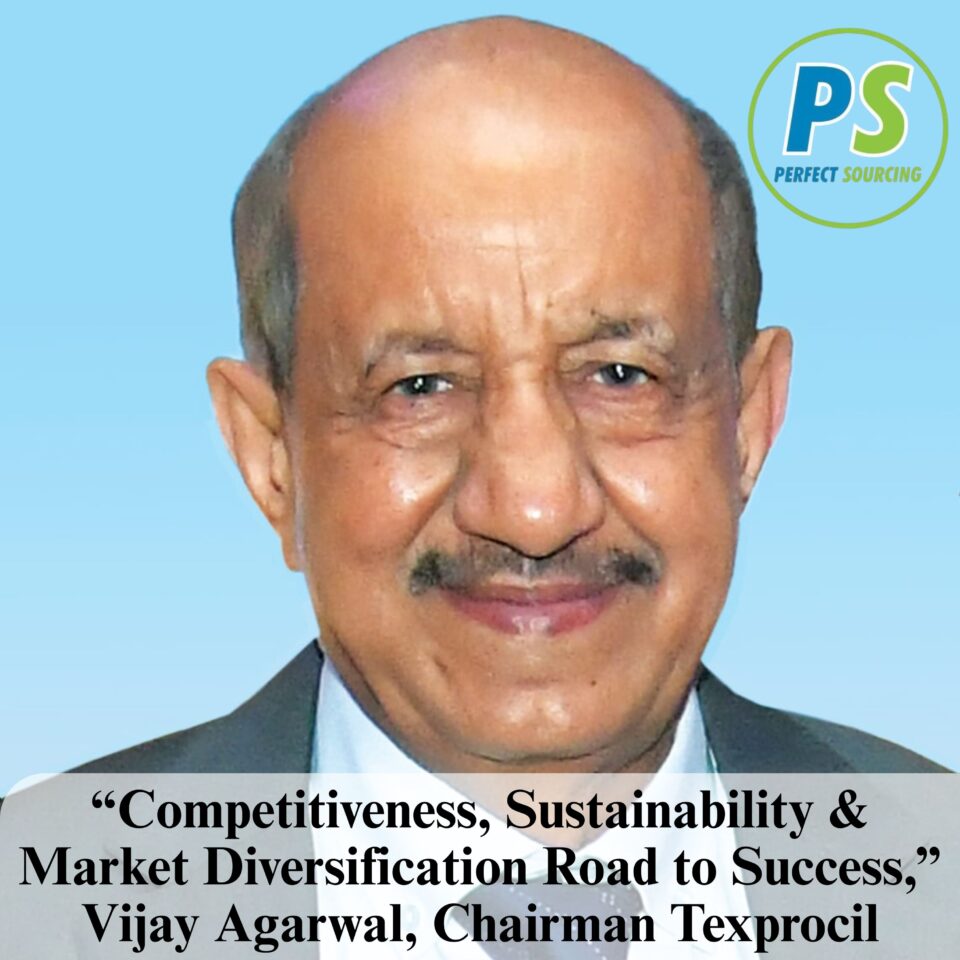
Few industry leaders have witnessed and shaped the evolution of India’s textile and apparel sector as closely as Shri Vijay Kumar Agarwal. With over five decades of entrepreneurial and industry leadership experience, he has been at the forefront of India’s transformation from a quota-driven manufacturing base to a globally integrated sourcing destination.
Founder, Promoter and Chairman of the Creative Group, Shri Agarwal began his journey in garment manufacturing and exports in 1974. An engineer and alumnus of VJTI, Mumbai, he successfully led the group’s expansion into a fully integrated textile enterprise encompassing fabric manufacturing, processing, embroidery, printing, garments, made-ups and home textiles. His strategic foresight enabled the company to adapt to changing global trade dynamics and emerge as a trusted supplier to leading international customers across the United States and Europe.
Beyond his entrepreneurial achievements, Shri Agarwal has made significant contributions to India’s export ecosystem through his long association with industry bodies. Having served in various leadership positions at the Apparel Export Promotion Council (AEPC), including as Chairman during 2006-07, he currently serves as Chairman of TEXPROCIL, where he is championing initiatives focused on market diversification, sustainability, traceability, trade facilitation and export competitiveness.
In this exclusive conversation with Perfect Sourcing, he shares his vision for the industry, the opportunities emerging from new trade agreements, and the roadmap for achieving India’s ambitious textile and apparel export aspirations.
PS: What are TEXPROCIL’s top priorities for the next three years?
Chairman: TEXPROCIL’s priorities are closely aligned with India’s vision of becoming a global textile manufacturing and sourcing hub. Over the next three years, we will focus on three key areas.
First, expanding India’s global market share across the cotton textile value chain by helping exporters consolidate presence in FTA markets where India has negotiated favourable access. Also, efforts have been undertaken to grow access to emerging markets in the Middle East, Africa, Latin America and East Asia, while strengthening our presence in traditional markets such as the US, EU, UK and Japan.
Second, enhancing competitiveness through policy advocacy, sustainability, traceability and compliance. As global buyers increasingly demand transparency and responsible sourcing, initiatives such as Kasturi Cotton Bharat, ESG awareness programmes and preparedness for evolving sustainability regulations will become even more important.
Third, strengthening export capabilities, particularly among MSMEs. While infrastructure and market access remain important, building knowledge and export preparedness is equally critical.
PS: What initiatives is TEXPROCIL undertaking to support MSME exporters?
Chairman: MSMEs form the backbone of India’s textile export ecosystem, and supporting their growth remains one of TEXPROCIL’s core priorities.
The Council regularly organises webinars, workshops, stakeholder consultations and outreach programmes on critical topics such as FTAs, Rules of Origin, export documentation, trade finance, logistics, Authorised Economic Operator (AEO) certification, sustainability regulations and market opportunities.
A significant initiative in this direction is TEXPROCIL’s Advanced Certificate Programme in International Trade (ACPIT), which provides structured training in international trade practices, customs procedures, trade agreements, logistics, export finance and global compliance requirements. The programme is helping exporters, professionals and young executives develop practical expertise that is increasingly essential in today’s global business environment.
PS: How is TEXPROCIL helping exporters connect with new markets and buyers globally?
Chairman: Market diversification has become a strategic necessity in today’s rapidly changing global environment. TEXPROCIL actively promotes Indian exporters across key international markets through participation in leading trade fairs, sourcing events, buyer-seller meets and trade delegations.
The Council works closely with Indian Missions abroad, international trade bodies and overseas buying organisations to create business opportunities for Indian exporters. Recent engagements in the GCC region, Latin America, Africa and other emerging markets have helped expand India’s sourcing footprint.
PS: What keeps you optimistic about India’s apparel and textile industry’s future despite increasing cost in apparel clusters, labour problems and global market uncertainties due to war situation?
Chairman: India’s textile industry has repeatedly demonstrated resilience and adaptability in the face of global challenges. Several structural strengths continue to inspire confidence about the sector’s future. India possesses one of the most integrated textile value chains in the world, ranging from fibre and yarn to fabrics, apparel and home textiles. The country also enjoys a large domestic market, entrepreneurial strength and deep manufacturing capabilities.
Government initiatives such as PM MITRA Parks, the PLI Scheme, the National Technical Textiles Mission, the Export Promotion Mission and various infrastructure development programmes are creating a stronger ecosystem for long-term growth. At the same time, global brands are increasingly looking to diversify sourcing destinations, creating significant opportunities for India.
I am also encouraged by the growing focus on sustainability, traceability and skill development. In this regard, the two ‘Gold Standards of Traceability’ introduced by TEXPROCIL – namely, “KC Track” Blockchain Platform for Kasturi Cotton Bharat and “General Certificate of Conformity (GCC)” Platform for conventional Indian cotton – are helping strengthen India’s reputation as a reliable, responsible and knowledge-driven sourcing destination.
PS: India has the potential to become a USD 100 billion textile and apparel export powerhouse. What are the three critical actions that industry, government, and brands must collectively take to make this vision a reality by 2030?
Chairman: First, India must significantly enhance scale and competitiveness by creating globally benchmarked manufacturing ecosystems supported by modern infrastructure, efficient logistics and advanced technology.
Second, we must secure wider market access through comprehensive FTAs and a stable export support framework.
Third, the entire ecosystem must embrace sustainability, innovation, workforce development and compliance. If these three pillars are pursued simultaneously, I firmly believe India can achieve and potentially exceed the USD 100 billion textile and apparel export target by 2030.
PS: What has been the impact of war and tariffs on textile and apparel exports from India and what steps has TEXPROCIL taken to neutralize the impact?
Chairman: Geopolitical conflicts, tariff uncertainties, supply-chain disruptions and rising freight costs have created challenges for exporters across the world. Certain markets have experienced slower demand growth, while sourcing patterns have become increasingly unpredictable.
TEXPROCIL has responded by intensifying market diversification efforts, organising awareness programmes, conducting stakeholder consultations and engaging closely with the Government on issues affecting exporters. While challenges remain, India has demonstrated resilience by expanding into newer markets and strengthening its reputation as a reliable sourcing partner.
PS: The increasing cost of manufacturing, workers moving towards online delivery jobs and war all have created one of the biggest challenges for our industry, how do you think manufacturers are handling the situation?
Chairman: Manufacturers are responding through a combination of productivity enhancement, automation, technology adoption and value-added product development.
Many companies are investing in modern machinery, lean manufacturing systems and digital technologies to improve efficiency and offset rising costs. Increasingly, businesses are also moving towards higher-value products where margins are stronger and customer relationships are more strategic.
As India advances towards higher export targets and deeper integration with global value chains, such capacity-building and skill development initiatives will play a vital role in enhancing competitiveness and creating a stronger foundation for sustainable export growth.
PS: If you had one message for policymakers and one message for textile and apparel exporters, what would they be?
Chairman: For policymakers, my message would be to continue supporting the sector through stable export policies, competitive market access arrangements, infrastructure development, affordable export finance and skill-building initiatives.
For exporters, my message would be to continuously invest in innovation, sustainability, compliance, market diversification and knowledge enhancement.
PS: Looking back at your long journey of over four decades in the textile and apparel industry, what has been the biggest transformation you have witnessed?
Chairman: The biggest transformation has been the evolution from a production-driven industry to a customer-centric and globally integrated value chain.
Earlier, competitiveness was largely determined by cost. Today, global buyers evaluate suppliers based on sustainability, traceability, compliance, innovation, speed-to-market and responsible sourcing practices.
Technology has transformed every aspect of business—from product development and manufacturing to supply chain management and customer engagement. At the same time, knowledge and compliance have become as important as manufacturing capability.
Few industry leaders have witnessed and shaped the evolution of India’s textile and apparel sector as closely as Shri Vijay Kumar Agarwal. With over five decades of entrepreneurial and industry leadership experience, he has been at the forefront of India’s transformation from a quota-driven manufacturing base to a globally integrated sourcing destination.
Founder, Promoter and Chairman of the Creative Group, Shri Agarwal began his journey in garment manufacturing and exports in 1974. An engineer and alumnus of VJTI, Mumbai, he successfully led the group’s expansion into a fully integrated textile enterprise encompassing fabric manufacturing, processing, embroidery, printing, garments, made-ups and home textiles. His strategic foresight enabled the company to adapt to changing global trade dynamics and emerge as a trusted supplier to leading international customers across the United States and Europe.
Beyond his entrepreneurial achievements, Shri Agarwal has made significant contributions to India’s export ecosystem through his long association with industry bodies. Having served in various leadership positions at the Apparel Export Promotion Council (AEPC), including as Chairman during 2006-07, he currently serves as Chairman of TEXPROCIL, where he is championing initiatives focused on market diversification, sustainability, traceability, trade facilitation and export competitiveness.
In this exclusive conversation with Perfect Sourcing, he shares his vision for the industry, the opportunities emerging from new trade agreements, and the roadmap for achieving India’s ambitious textile and apparel export aspirations.
PS: What are TEXPROCIL’s top priorities for the next three years?
Chairman: TEXPROCIL’s priorities are closely aligned with India’s vision of becoming a global textile manufacturing and sourcing hub. Over the next three years, we will focus on three key areas.
First, expanding India’s global market share across the cotton textile value chain by helping exporters consolidate presence in FTA markets where India has negotiated favourable access. Also, efforts have been undertaken to grow access to emerging markets in the Middle East, Africa, Latin America and East Asia, while strengthening our presence in traditional markets such as the US, EU, UK and Japan.
Second, enhancing competitiveness through policy advocacy, sustainability, traceability and compliance. As global buyers increasingly demand transparency and responsible sourcing, initiatives such as Kasturi Cotton Bharat, ESG awareness programmes and preparedness for evolving sustainability regulations will become even more important.
Third, strengthening export capabilities, particularly among MSMEs. While infrastructure and market access remain important, building knowledge and export preparedness is equally critical.
PS: What initiatives is TEXPROCIL undertaking to support MSME exporters?
Chairman: MSMEs form the backbone of India’s textile export ecosystem, and supporting their growth remains one of TEXPROCIL’s core priorities.
The Council regularly organises webinars, workshops, stakeholder consultations and outreach programmes on critical topics such as FTAs, Rules of Origin, export documentation, trade finance, logistics, Authorised Economic Operator (AEO) certification, sustainability regulations and market opportunities.
A significant initiative in this direction is TEXPROCIL’s Advanced Certificate Programme in International Trade (ACPIT), which provides structured training in international trade practices, customs procedures, trade agreements, logistics, export finance and global compliance requirements. The programme is helping exporters, professionals and young executives develop practical expertise that is increasingly essential in today’s global business environment.
PS: How is TEXPROCIL helping exporters connect with new markets and buyers globally?
Chairman: Market diversification has become a strategic necessity in today’s rapidly changing global environment. TEXPROCIL actively promotes Indian exporters across key international markets through participation in leading trade fairs, sourcing events, buyer-seller meets and trade delegations.
The Council works closely with Indian Missions abroad, international trade bodies and overseas buying organisations to create business opportunities for Indian exporters. Recent engagements in the GCC region, Latin America, Africa and other emerging markets have helped expand India’s sourcing footprint.
PS: What keeps you optimistic about India’s apparel and textile industry’s future despite increasing cost in apparel clusters, labour problems and global market uncertainties due to war situation?
Chairman: India’s textile industry has repeatedly demonstrated resilience and adaptability in the face of global challenges. Several structural strengths continue to inspire confidence about the sector’s future. India possesses one of the most integrated textile value chains in the world, ranging from fibre and yarn to fabrics, apparel and home textiles. The country also enjoys a large domestic market, entrepreneurial strength and deep manufacturing capabilities.
Government initiatives such as PM MITRA Parks, the PLI Scheme, the National Technical Textiles Mission, the Export Promotion Mission and various infrastructure development programmes are creating a stronger ecosystem for long-term growth. At the same time, global brands are increasingly looking to diversify sourcing destinations, creating significant opportunities for India.
I am also encouraged by the growing focus on sustainability, traceability and skill development. In this regard, the two ‘Gold Standards of Traceability’ introduced by TEXPROCIL – namely, “KC Track” Blockchain Platform for Kasturi Cotton Bharat and “General Certificate of Conformity (GCC)” Platform for conventional Indian cotton – are helping strengthen India’s reputation as a reliable, responsible and knowledge-driven sourcing destination.
PS: India has the potential to become a USD 100 billion textile and apparel export powerhouse. What are the three critical actions that industry, government, and brands must collectively take to make this vision a reality by 2030?
Chairman: First, India must significantly enhance scale and competitiveness by creating globally benchmarked manufacturing ecosystems supported by modern infrastructure, efficient logistics and advanced technology.
Second, we must secure wider market access through comprehensive FTAs and a stable export support framework.
Third, the entire ecosystem must embrace sustainability, innovation, workforce development and compliance. If these three pillars are pursued simultaneously, I firmly believe India can achieve and potentially exceed the USD 100 billion textile and apparel export target by 2030.
PS: What has been the impact of war and tariffs on textile and apparel exports from India and what steps has TEXPROCIL taken to neutralize the impact?
Chairman: Geopolitical conflicts, tariff uncertainties, supply-chain disruptions and rising freight costs have created challenges for exporters across the world. Certain markets have experienced slower demand growth, while sourcing patterns have become increasingly unpredictable.
TEXPROCIL has responded by intensifying market diversification efforts, organising awareness programmes, conducting stakeholder consultations and engaging closely with the Government on issues affecting exporters. While challenges remain, India has demonstrated resilience by expanding into newer markets and strengthening its reputation as a reliable sourcing partner.
PS: The increasing cost of manufacturing, workers moving towards online delivery jobs and war all have created one of the biggest challenges for our industry, how do you think manufacturers are handling the situation?
Chairman: Manufacturers are responding through a combination of productivity enhancement, automation, technology adoption and value-added product development.
Many companies are investing in modern machinery, lean manufacturing systems and digital technologies to improve efficiency and offset rising costs. Increasingly, businesses are also moving towards higher-value products where margins are stronger and customer relationships are more strategic.
As India advances towards higher export targets and deeper integration with global value chains, such capacity-building and skill development initiatives will play a vital role in enhancing competitiveness and creating a stronger foundation for sustainable export growth.
PS: If you had one message for policymakers and one message for textile and apparel exporters, what would they be?
Chairman: For policymakers, my message would be to continue supporting the sector through stable export policies, competitive market access arrangements, infrastructure development, affordable export finance and skill-building initiatives.
For exporters, my message would be to continuously invest in innovation, sustainability, compliance, market diversification and knowledge enhancement.
PS: Looking back at your long journey of over four decades in the textile and apparel industry, what has been the biggest transformation you have witnessed?
Chairman: The biggest transformation has been the evolution from a production-driven industry to a customer-centric and globally integrated value chain.
Earlier, competitiveness was largely determined by cost. Today, global buyers evaluate suppliers based on sustainability, traceability, compliance, innovation, speed-to-market and responsible sourcing practices.
Technology has transformed every aspect of business—from product development and manufacturing to supply chain management and customer engagement. At the same time, knowledge and compliance have become as important as manufacturing capability.
