
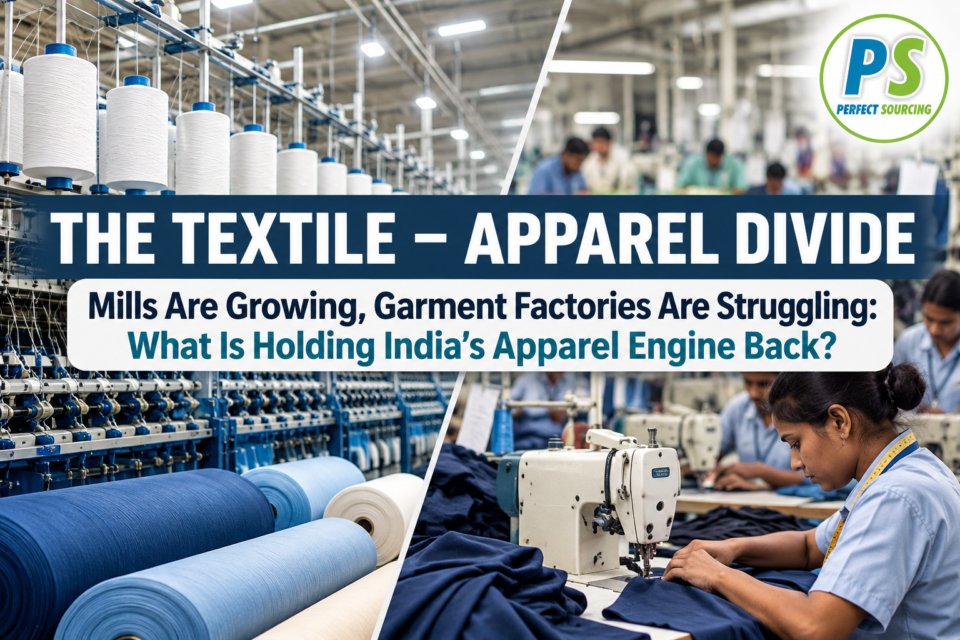
India’s textile industry appears to be sending two very different signals. At one end of the value chain, textile manufacturing is registering strong growth. At the other, apparel production is struggling to sustain momentum. For an industry that depends on the seamless movement of raw materials from spinning mills to fabric manufacturers and garment factories, this disconnect raises an important question: if the upstream industry is expanding, why is the downstream apparel sector failing to keep pace?
The latest Index of Industrial Production (IIP) data for August 2026 brings the contrast into sharp focus. Textile production grew 13.1% year-on-year, while wearing apparel manufacturing declined 7.4%. For April–August 2026, textile production recorded cumulative growth of 11.9%, whereas apparel production contracted 5.6%.
The numbers do not necessarily indicate that the entire textile industry is weakening. Instead, they reveal that different segments of the value chain are responding differently to prices, inventories, demand and uncertainty.
THE NUMBERS TELL TWO DIFFERENT STORIES
| Indicator | August 2026 | April–August 2026 |
|---|---|---|
| Textile manufacturing | +13.1% | +11.9% |
| Wearing apparel manufacturing | −7.4% | −5.6% |
| Overall industrial production | +8.0% | — |
The contrast becomes more significant when viewed against the broader industrial backdrop. India’s overall industrial production grew 8% in August, compared with 6.7% in July. Eighteen of the 23 manufacturing industry groups recorded positive growth during the month.
Apparel manufacturing, however, remained among the weaker performers.
The distinction matters because textile and apparel production represent different stages of the manufacturing process. Textile production encompasses upstream activities such as spinning, weaving, knitting and fabric processing. Apparel manufacturing is closer to the final consumer and is more directly influenced by fashion demand, retail inventory, buyer orders and export schedules.
Consequently, a rise in textile output does not automatically translate into an equivalent increase in garment production.
WHY ARE TEXTILE MILLS OUTPERFORMING GARMENT FACTORIES?
1. Higher input prices can lift production without strengthening demand
One explanation lies in raw-material and intermediate-product pricing.
Rising yarn prices have influenced the upstream production trend. Higher prices and inventory movements can affect the value-chain dynamics even when downstream demand remains subdued.
For garment manufacturers, however, higher yarn and fabric prices can create a different set of pressures. A factory working on orders negotiated months earlier may have limited room to absorb unexpected increases in input costs. If the buyer refuses a price revision, the additional cost can erode already-thin margins.
For a garment exporter, higher input costs are therefore not simply a procurement issue. They can influence whether an order remains commercially viable.
- Apparel manufacturing is more exposed to global retail uncertainty
The apparel business operates on a different demand cycle from yarn and fabric manufacturing. International brands and retailers continuously adjust purchasing plans according to consumer spending, inventory levels, markdowns and their expectations for the coming season. When retailers become cautious, new orders can be delayed, reduced or shifted to suppliers offering better prices and shorter lead times.
Geopolitical tensions, tariff uncertainty and disruptions to international trade add further complexity. Buyers may postpone commitments while assessing landed costs and market conditions.
The impact travels quickly down the supply chain. A retailer’s decision to reduce orders can affect an exporter’s production schedule, which in turn influences fabric procurement, accessory purchases, labour deployment and factory utilisation.
- The order book matters more than installed capacity
India has substantial manufacturing capacity across spinning, fabric production and garmenting. But capacity alone does not guarantee growth.
Garment factories require a dependable pipeline of orders to maintain efficient production. When volumes become unpredictable, manufacturers face difficult operational choices: retain workers and absorb underutilisation, hire additional labour when orders arrive, or operate below capacity while waiting for demand to recover. This creates a cycle in which uncertainty itself becomes a cost.
Exporters must maintain skilled teams, meet compliance requirements and deliver on time, even when order visibility is limited. Sudden fluctuations in demand make workforce planning, production scheduling and cash-flow management more difficult.
The challenge is not merely to manufacture more garments. It is to maintain a stable, productive and commercially sustainable manufacturing ecosystem.
THE MISSING LINK: CONVERTING FABRIC INTO VALUE
India’s textile industry has long possessed strengths in cotton, yarn, fabric and a wide range of textile products. Yet the current divergence raises a strategic question: how effectively is the country converting its upstream manufacturing strengths into higher-value finished products?
Garments are where several layers of value converge—design, product development, merchandising, pattern-making, cutting, stitching, finishing, quality assurance, branding and logistics.
A stronger apparel ecosystem can create additional value from the same textile base while generating employment across manufacturing clusters.
If fabric production expands but garment orders remain weak, the industry risks losing opportunities to capture that downstream value. It may also experience mismatches between available capacity, inventory and actual customer demand.
The solution is not simply to increase garmenting capacity. India needs stronger connections between mills, processors, accessory manufacturers, garment exporters and international buyers.
India’s Apparel Exports Stuck On Same Number…
India’s ambition to raise apparel exports to approximately US$40 billion by 2030 will require a more sustained expansion of finished-garment manufacturing, stronger market access and improved competitiveness.
The opportunity is significant, but the execution challenge is equally important.
Government initiatives can provide a framework for improving the industry’s competitiveness. Programmes such as PM MITRA, the Production Linked Incentive (PLI) Scheme for Textiles, SAMARTH and export-promotion measures address different aspects of investment, manufacturing capability, skills and market access.
However, market access is only one part of the equation. Exporters must still meet buyer expectations on price, product quality, delivery and compliance. Greater access to a market does not automatically guarantee orders.
Similarly, investment incentives have to translate into commercially viable capacity, improved productivity and stronger integration between textile and apparel manufacturing.
The immediate priority is to ensure that policy support reaches the operational challenges faced by manufacturers, particularly smaller and medium-sized businesses that have limited room to absorb cost increases or prolonged periods of under utilisation.
WHAT NEEDS TO CHANGE?
For textile mills, the priority is to align output with sustainable demand and build stronger relationships with downstream customers. For garment manufacturers, it is to improve productivity, reduce waste, strengthen product development and negotiate orders that adequately reflect cost and complexity.
For sourcing companies and brands, closer collaboration with Indian suppliers can help improve demand visibility, shorten development cycles and create more predictable production plans.
Industry associations and policymakers, meanwhile, need to keep attention on the practical barriers affecting garment manufacturing—from workforce availability and productivity to logistics, financing and access to competitive inputs.
The next phase of growth will depend on whether India can convert its textile strengths into a more competitive, responsive and profitable apparel ecosystem.
For the industry, the key question is no longer simply how much yarn or fabric India can produce. It is how effectively that capacity can support finished products, stronger export relationships, better margins and more sustainable employment.
India’s textile opportunity will ultimately be measured not by how much it manufactures at the beginning of the value chain, but by how much value it captures by the end.PS
