

The approval of 96 companies under the Textile PLI Scheme is more than a policy milestone. It signals a structural shift towards MMF, technical textiles and next-generation manufacturing that could redefine India’s position in global sourcing over the next decade.
When the Government announced the Production Linked Incentive (PLI) Scheme for Textiles, the objective was clear—to encourage investments in segments where India had long underperformed despite being one of the world’s largest textile producers. Five years later, the approval of 96 companies under Round III of the scheme suggests that the industry is finally responding.
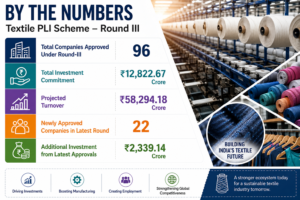
The numbers are significant. The approved companies have committed investments of ₹12,822.67 crore and are projected to generate a turnover of over ₹58,294 crore. The latest batch of 22 approved applicants alone is expected to bring in fresh investments of ₹2,339 crore and create more than 36,000 jobs.
For decades, India’s textile industry has been heavily dependent on cotton, even as global consumption increasingly shifted towards man-made fibres (MMF) and performance textiles.
Today, nearly 70 per cent of global fibre consumption is based on synthetic and blended fibres, yet India’s export basket continues to be dominated by cotton products. The PLI scheme is attempting to correct this imbalance by encouraging investments in MMF apparel, MMF fabrics and technical textiles.
This shift could prove transformational for the industry. Global demand is increasingly concentrated in categories such as activewear, athleisure, sportswear, outerwear, performance fabrics and functional apparel—segments where India has historically lacked scale.
The new investments are expected to create capacities in precisely these high-growth areas, enabling Indian manufacturers to compete more effectively with established sourcing destinations such as China, Vietnam and Bangladesh.
Another major outcome of the latest approvals is the growing focus on technical textiles. Unlike conventional textiles, technical textiles serve sectors such as healthcare, infrastructure, defence, automotive, filtration and industrial applications.
The impact of these investments will also be felt geographically. New textile capacities are expected to come up across major manufacturing states including Gujarat, Tamil Nadu, Karnataka, Madhya Pradesh, Andhra Pradesh, Telangana and Odisha. This could lead to the emergence of new textile clusters focused on MMF and technical textiles, complementing traditional centres such as Tiruppur, Surat and Ludhiana.
The technology dimension of these investments is equally important. Since many of these projects are greenfield facilities, companies have the opportunity to adopt advanced manufacturing technologies from the outset. Automation, digital production systems, AI-enabled quality management, smart factories and Industry 4.0 solutions are likely to become standard features of the new generation of textile plants. This could significantly enhance productivity and competitiveness while helping manufacturers meet the increasingly stringent requirements of global buyers.
Employment generation remains one of the strongest arguments in favour of the scheme. The latest approvals alone are expected to create over 36,000 jobs,more importantly, many of these jobs will be in modern manufacturing segments requiring higher skill levels, creating opportunities for workforce upgradation and long-term industrial development.
From a sourcing perspective, the timing could not be better. Global brands are actively diversifying supply chains and reducing overdependence on single-country sourcing models. India’s ability to offer large-scale MMF and technical textile manufacturing capacities will strengthen its position as a preferred sourcing destination. Buyers are increasingly seeking suppliers capable of delivering innovation, sustainability, speed and scale—areas where the new investments could significantly enhance India’s competitiveness.
However, the success of the scheme will ultimately depend on execution. Investment commitments must translate into operational factories, commercial production and export growth. Issues such as raw material competitiveness, infrastructure readiness, logistics efficiency and availability of skilled manpower will determine how quickly these investments generate tangible results.
Nevertheless, the direction is clear. The approval of 96 companies under Round III is not merely another government announcement. It represents a structural shift in the Indian textile industry’s investment priorities.
For exporters, manufacturers, technology providers and investors, the message is unmistakable: India’s next textile growth cycle will be built on MMF, technical textiles, advanced manufacturing and scale.
Perfect Sourcing Insight
The most significant takeaway from the latest PLI approvals is not the number of companies selected, but the direction of investment. Capital is flowing towards MMF apparel, performance textiles and technical textile applications—the very categories expected to dominate global textile demand in the years ahead. If executed successfully, these investments could mark the beginning of India’s transition from a cotton-centric textile economy to a diversified, technology-driven manufacturing powerhouse.
.
For Perfect Sourcing, the real story is not that 96 companies have been approved. The real story is how this could reshape India’s textile industry over the next 5-10 years.
- The Biggest Winner Will Be MMF Apparel
For decades, India’s textile industry has remained heavily dependent on cotton, while nearly 70% of global apparel consumption is based on man-made fibres such as polyester, nylon, spandex and blends. Countries like China, Vietnam and Bangladesh built their export success on these categories while India lagged behind. The latest PLI approvals are expected to accelerate investments in MMF apparel and fabrics, helping India align production with global demand trends.
- India’s Export Basket Will Become More Diverse
The new investments are likely to create capacity in activewear, athleisure, sportswear, outerwear, performance fabrics and technical textile products—categories where global demand is growing faster than traditional apparel. This diversification could help India capture a larger share of global sourcing business.
- The Risk: Execution Will Matter More Than Approvals
The industry’s experience with earlier government schemes shows that approvals alone do not guarantee success. The real challenge will be:
- Timely project execution
- Availability of skilled manpower
- Competitive MMF raw material pricing
- Faster infrastructure development
- Efficient logistics
- Access to export markets
