


Industry leaders urge policy action to strengthen global competitiveness amid FTA opportunities
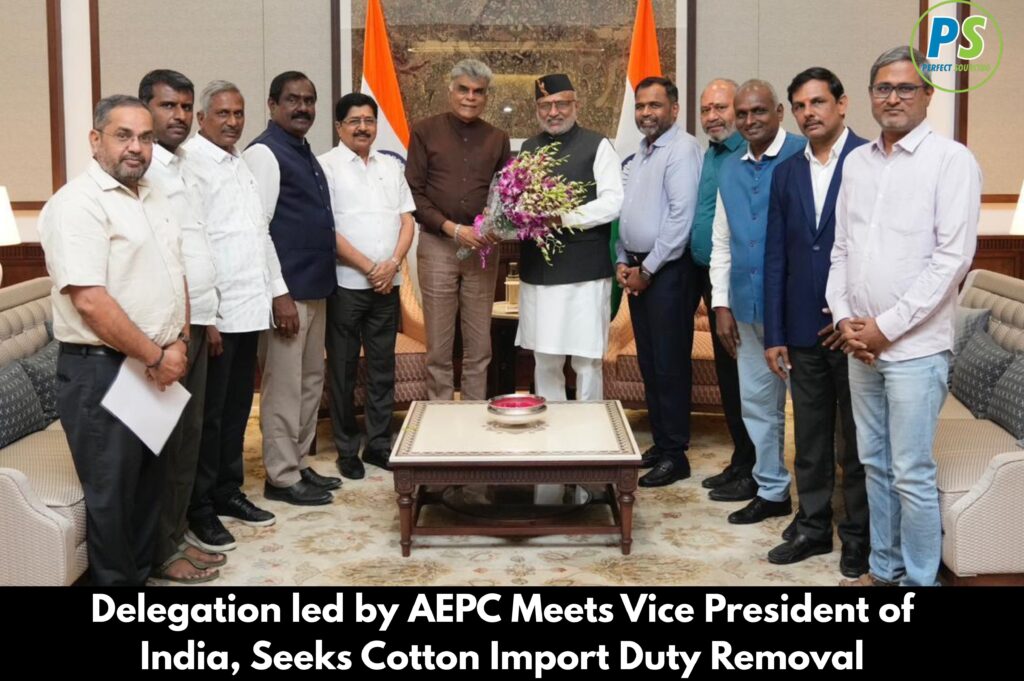
A high-level delegation led by Dr. A. Sakthivel, Chairman of the Apparel Export Promotion Council (AEPC), met with the Hon’ble Vice President of India, Shri C. P. Radhakrishnan, to present a representation seeking the removal of the 11 percent import duty on cotton. The delegation emphasized that eliminating this duty is critical for strengthening the global competitiveness of India’s apparel and textile sector.
The timing of this intervention is significant. India’s apparel and textile industry is poised at a crucial growth inflection, with several newly signed Free Trade Agreements (FTAs) expected to unlock substantial export opportunities in key international markets. However, the delegation cautioned that India’s competitiveness could be undermined by elevated raw material costs driven by the current cotton import duty structure. Removing this duty, the industry argued, would enable Indian exporters to compete more effectively with neighboring countries that enjoy preferential access to quality cotton at globally competitive prices.
The delegation underscored a critical supply-demand imbalance. India’s textile industry requires approximately 337 lakh bales of cotton in the current year, yet projected cotton arrivals for the 2025-26 season are estimated at just 292.15 lakh bales—a shortfall of nearly 45 boils bales. This supply-demand gap is intensifying pressure on spinning mills and downstream textile manufacturers, compounding the challenges posed by limited availability of quality raw materials and rising input costs.
Dr. Sakthivel emphasized the sector’s strategic importance to India’s economy. “The apparel and textile industry is one of the country’s largest employment generators and a critical driver of export growth and foreign exchange earnings,” he stated. He urged the government to provide timely policy support through the removal of cotton import duty, enabling the industry to fully capitalize on emerging global opportunities and position India as a stronger, more competitive sourcing destination in the post-FTA landscape.
The representation highlighted how rationalizing cotton import duty would yield multiple benefits: enabling Indian apparel exporters to attract increased sourcing business from FTA partner countries, strengthening supply chain efficiency, and supporting manufacturers in securing larger global orders. Industry representatives stressed that these policy improvements are essential to realizing the full potential of India’s recent trade agreements.
The delegation included representatives from leading textile and apparel industry associations in the Tirupur cluster, including the Tirupur Exporters Association (TEA), SIHMA, TTPK, DAT, TEKMA, TEKPA and SIIMKA.
Their collective participation underscored the unified position of India’s textile and apparel ecosystem on this critical policy matter.