


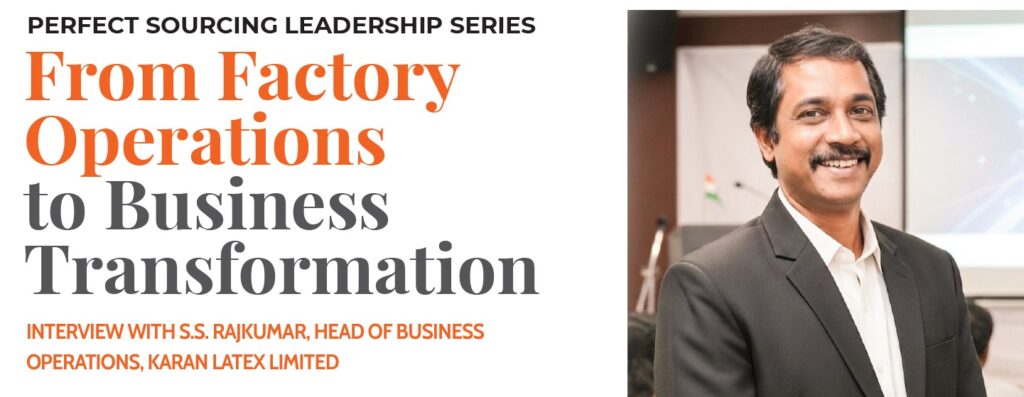
INTERVIEW WITH S.S. RAJKUMAR, HEAD OF BUSINESS OPERATIONS, KARAN LATEX LIMITED
In today’s highly competitive garment manufacturing industry, transformation is about far more than increasing production capacity. It requires a clear vision, disciplined execution, capable leadership, and a culture that embraces continuous improvement.
Few industry leaders understand this better than S.S. Rajkumar, Head of Business Operations at Karan Latex Limited. Since joining the company in January 2021, he has led a remarkable transformation journey, evolving the organization from a factory producing only two product categories—Breeches and Tights—into a diversified manufacturing operation producing nearly 30 fashion and lifestyle product categories.
The transformation extended far beyond product diversification. It involved redesigning operational systems, strengthening quality management, implementing Lean Manufacturing and 5S, developing multi-skilled teams, standardizing processes across four factories, and creating a scalable manufacturing model capable of meeting the evolving expectations of global brands.
In this edition of the PERFECT SOURCING Leadership Series, Rajkumar shares insights into leadership, operational excellence, productivity, Quality-Cost-Delivery (QCD), and the principles that distinguish world-class factories from average manufacturers.
What is the biggest mistake manufacturing leaders make while building teams?
The biggest mistake is focusing on short-term results instead of building sustainable systems and developing people. Many organisations accept high employee attrition as inevitable, but a stable and skilled workforce is the foundation of operational excellence.
High attrition increases training costs, reduces productivity, weakens quality, and affects organizational culture.
Another common mistake is failing to establish clear ownership and accountability. Department heads should have defined responsibilities and decision-making authority.
When too many people interfere in operational decisions, accountability disappears.
Manufacturing should also be driven by data rather than assumptions.
Every factory must measure performance across Men, Machine, Material, Method and Quality, while tracking both individual and team performance through structured review mechanisms.
Equally important is having a clear operational roadmap—from product development and costing to supplier management, production planning and escalation procedures.
Every employee should understand what is expected, by when, and who is responsible.
One principle that has guided my career is R.R.R. Management—Right Time, Right Person, Right Question.
Combined with data-driven decision-making and accountability, it creates high-performing teams capable of sustainable growth.
What was the biggest operational challenge when you joined the organisation?
When I joined Karan Latex in January 2021, the factory was producing only two product categories. The challenge was to transform it into a versatile apparel manufacturing organization capable of serving multiple fashion segments.
This required changes across every function—product development, technical capability, production planning, quality management, compliance, manpower development and operational systems. Our focus was on building robust processes, developing multiskilled teams, strengthening quality systems and creating a culture of continuous improvement. Over the past few years, this transformation has enabled us to manufacture nearly 30 different product categories while significantly improving operational capability.
What strategic changes enabled this transformation?
The first priority was building a performance-driven culture capable of handling multiple product categories.
We strengthened operational foundations through process standardisation, Lean Manufacturing, visual management and 5S practices. These initiatives improved workplace organisation, productivity, accountability and operational discipline.
People development became another major focus. We introduced comprehensive skill matrices, invested in operator and supervisor training, and developed multi-skilled teams capable of handling different products and manufacturing complexities.
Perhaps the biggest transformation was changing the organizational mindset. We encouraged employees to believe that any product could be successfully developed and manufactured within our facilities.
That confidence became one of our greatest strengths.
How did you standardize systems across multiple factories?
Creating success in one factory is difficult; replicating it across multiple locations is even more challenging. Our objective was to build systems rather than depend on individuals. We developed standard operating procedures (SOPs), uniform workflows, training modules, quality systems and performance measurement tools that could be consistently implemented across every facility.
Leadership development was equally important. Instead of relying heavily on external hiring, we invested in developing managers internally, empowering them to take ownership and lead change. We also ensured every employee understood the company’s Vision and Mission.
Today, our operations are supported by standardised systems, capable leaders and a strong organizational structure that enables consistent quality, productivity and customer satisfaction across all factories.
What were the biggest challenges in aligning four factories under one vision?
Each factory had its own culture, management style and operating practices. Aligning them required changing mindsets before changing systems. We standardised processes, introduced common performance expectations and invested heavily in leadership capability. Managers were trained not only to supervise operations but also to solve problems, develop teams and drive continuous improvement.
Regular reviews, KPI monitoring, transparent communication and cross-functional collaboration helped ensure every factory moved in the same direction.
Ultimately, operational alignment is about people. Once teams embraced the shared vision, transformation accelerated significantly.
What does operational excellence mean beyond productivity?
Productivity is only an outcome. True operational excellence means building a sustainable organization that consistently delivers quality, customer satisfaction, compliance, profitability and employee development.
Operational excellence exists when:
- Customers trust you with complex products.
- Quality becomes a habit rather than an inspection activity.
- Teams solve problems proactively.
- Factories scale without losing control.
- Employees continuously develop new skills and take ownership.
It is about having the right people, the right processes and the right culture.
Every factory must measure performance across Men, Machine, Material, Method and Quality, while tracking both individual and team performance through structured review mechanisms.”