


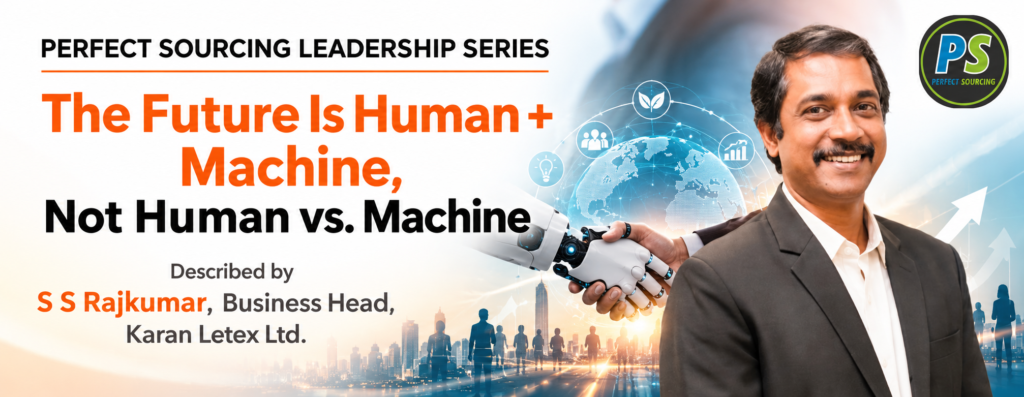
What happens when a machine knows the numbers, predicts a problem and recommends a solution—but cannot fully understand what is happening on the factory floor? In the race towards smart manufacturing, the biggest question may not be how much technology can do, but how wisely we choose to use it. After three decades in the textile and garment manufacturing industry, SS Rajkumar believes the future is not a contest between human intelligence and artificial intelligence. It is a partnership between the two.
As AI and automation reshape manufacturing, he makes a compelling case for a future in which machines bring speed, data and precision, while people contribute experience, judgement and accountability. After all, in manufacturing, the smartest decision is not always the one made fastest—it is the one that takes the context into account.
AI and automation are exceptionally powerful at processing large volumes of data, identifying patterns, monitoring performance, predicting risks and executing repetitive tasks with speed and consistency. However, manufacturing is not just about data. It is also about people, materials, quality, customer expectations, unexpected situations and practical experience on the shop floor.
A system may tell us what is happening, and AI may even predict what is likely to happen. But an experienced leader must still ask why it is happening, what it means for the business and what we should do about it.
This distinction is particularly important in garment manufacturing. Suppose an AI system identifies a production line operating below its expected efficiency. The technology can immediately highlight the deviation. However, the underlying reason could be a new style, fabric behaviour, operator training, machine condition, quality requirements or a coordination issue between departments. The dashboard can identify the symptom; human experience must interpret the situation.
Therefore, I do not see the future as Human vs. Machine. I see it as Human + Machine.
Three Principles for Manufacturers:
1. Automate repetition, not responsibility.
Tasks that are repetitive, measurable and rule-based should be automated wherever practical. This allows people to focus on higher-value activities.
2. Use AI to challenge thinking, not replace it.
When AI provides a recommendation, leaders should encourage their teams to ask: What is the evidence? What could the system be missing? Does this make sense on the shop floor? The objective is not to accept AI blindly, but to combine machine intelligence with human experience.
3. Retain human accountability at critical decision points.
Decisions involving customer commitments, quality, safety, significant costs, people or business reputation should be subject to appropriate human oversight. Technology can provide information and options, but leadership must retain accountability.
I also believe that successful automation should not be measured simply by how many people we can eliminate. A much more meaningful question is:
“How many people can we empower to become more capable through technology?”
When automation removes repetitive work, our people should have more time for problem-solving, innovation, quality improvement and continuous improvement. That is where technology creates its greatest value for people.
The leaders of tomorrow will therefore need two kinds of intelligence: digital intelligence to understand what technology can do, and human intelligence to understand what technology should do.
After three decades in manufacturing, my belief can be expressed in one simple principle:
“Let technology provide the speed, data and precision; let human beings provide the experience, judgement and responsibility.”
If AI Cannot Explain Its Reasoning, Would I Trust It?
If an AI system can perform a task faster and more cheaply than a human but cannot explain its reasoning, would you trust it with an important business decision? What safeguards would you demand?
My answer is simple: I would trust AI to support an important business decision, but I would not allow it to own that decision.
AI can process millions of data points, identify patterns and provide recommendations far faster than a human being. This capability is extremely valuable. However, when a decision has a significant impact on quality, customers, costs, people or the organisation’s reputation, speed and accuracy alone are not enough. Context and accountability matter equally.
In manufacturing, a system may tell us that a production line is underperforming. It may even recommend a particular course of action. But an experienced leader will still ask: What is the actual reason? Is it a material issue? Is it a new style? Is there a machine problem? Is the team still undergoing training? Have the quality requirements changed?
AI can identify the signal; human experience helps us understand the situation behind it.
Therefore, I would follow a simple principle:
The greater the business consequences, the greater the level of human oversight required.
I would expect five safeguards:
1. Human accountability
Critical decisions should require appropriate human review and approval. AI can make recommendations, but leadership must remain accountable.
2. Data transparency
We should understand what data the system uses, whether that data is reliable and what limitations might affect its recommendations.
3. Validation before implementation
AI recommendations should be tested against historical data, in controlled settings and through actual shop-floor results before being relied upon in critical operations.
4. Continuous monitoring
An AI system should never be treated as something we can simply install and forget. Its accuracy, outcomes and unexpected errors must be monitored continuously.
5. Human override
Experienced managers must have the authority to question or override an AI recommendation when business circumstances or real-world conditions justify doing so.
Most importantly, leaders must create an environment in which employees are encouraged to question technology intelligently. Accepting every AI recommendation without critical thinking is not digital transformation—it is simply transferring responsibility to a machine.
If AI gives a manager better information, the manager can make a better decision. If AI eliminates repetitive analysis, people can spend more time solving complex problems. If automation reduces routine work, employees can focus on innovation, quality and improvement.
So, I would not ask:
“Can AI make this decision?”
I would ask:
“What decisions should AI make, what decisions should humans make, and where should they work together?”
That, in my view, is the foundation of responsible smart manufacturing.
“Trust the machine for its intelligence, but keep the responsibility with people.”
________________________________________
Digital Transformation: Faster Is Not Always Better
In textile and garment manufacturing, I have learned that speed is an advantage only when we are moving in the right direction. Technology can provide information in seconds, but it cannot automatically guarantee that the decisions based on that information will be right.
Digital transformation should therefore not be about making every decision faster. It should be about improving the quality of our decisions.
In a modern manufacturing environment, we can have real-time dashboards, AI predictions, automated alerts and data from every stage of production. This gives leaders tremendous visibility. However, more data does not automatically translate into better decisions. The real leadership skill lies in knowing which information matters, understanding the context and acting with discipline.
I would focus on five principles.
1. First, establish the right objective before introducing technology.
Technology should solve a clearly defined business problem. If the objective is unclear, automation may simply make an inefficient process run faster.
2. Second, create a “data + experience” culture.
Data tells us what is happening; experience helps us understand why. Leaders should encourage teams to combine real-time information with shop-floor knowledge before making important decisions.
3. Third, build decision checkpoints.
Not every AI alert or dashboard signal should immediately trigger action. For important decisions, there should be a simple process: identify → verify → understand → decide → review.
4. Fourth, measure outcomes—not just speed.
A CEO should ask not only, “How quickly did we make the decision?” but also, “Did the decision improve quality, productivity, delivery, costs and customer satisfaction?” The outcome matters more than the response time.
5. Finally, create a culture in which people can challenge the system.
If the data suggests one thing but the shop floor indicates something different, the answer should not be to follow the dashboard blindly. We should investigate the discrepancy. Sometimes the system is right; sometimes a human being sees something the system cannot yet understand.
In my view, the greatest benefit of digital transformation is not that a company can make 1,000 decisions instead of 100. It is that the company can make better-informed decisions with greater confidence and consistency.
For example, in garment manufacturing, real-time production data can immediately show that a line is falling behind its target. That information is useful. However, the leadership response should go beyond simply increasing pressure on the line. We must understand whether the root cause lies in material availability, machine performance, operator capability, quality requirements, planning or process flow.
Technology gives us visibility; leadership gives that visibility meaning.
The future belongs to organisations that can combine the speed of technology with the patience of sound judgement.