


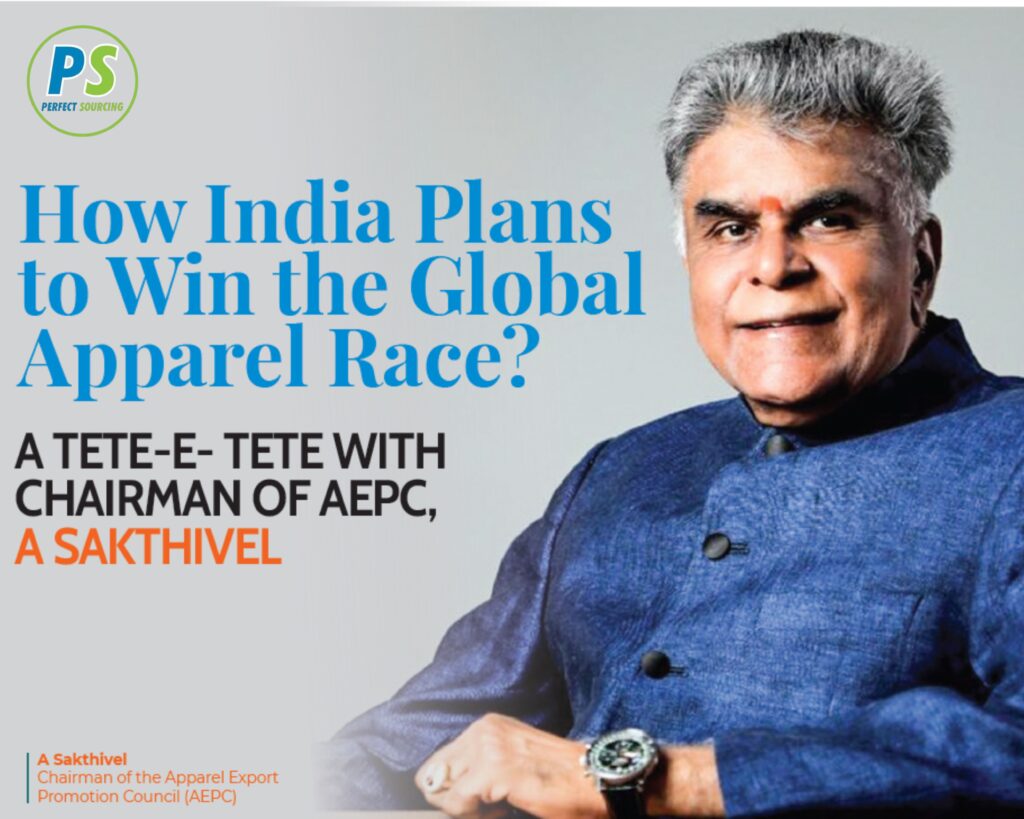
How India Plans to Win the Global Apparel Race?
Few sectors have the power to create jobs, drive exports, and strengthen India’s manufacturing story quite like apparel. Yet the industry today finds itself navigating a complex landscape marked by rising costs, labour shortages, shifting trade dynamics, and growing sustainability expectations. At the same time, global brands are actively looking beyond traditional sourcing destinations, creating a rare window of opportunity for India.
For Dr. A. Sakthivel, Chairman of the Apparel Export Promotion Council (AEPC), this moment is about more than just increasing exports—it’s about repositioning India as a trusted, future-ready sourcing partner for the world. From expanding into new markets and strengthening MSME exporters to accelerating growth in man-made fibre apparel and leveraging Free Trade Agreements, his focus is firmly on building long-term competitiveness.
In this conversation with Team PERFECT SOURCING , Sakthivel discusses the industry’s biggest challenges, the opportunities emerging from changing global supply chains, and the steps needed to transform India’s apparel sector into a global powerhouse by 2030.
PS: What are AEPC’s top priorities for the next three years?
Chairman: Our immediate focus is on accelerating apparel exports through deeper market diversification, better utilization of India’s Free Trade Agreements (FTAs), and expanding product offerings, especially in the man-made fibre (MMF) segment. Over the next three to five years, we want to position India as a preferred global sourcing destination by strengthening our capabilities in branding, sustainability, and design-led exports.
We also see significant opportunities in MMF apparel, activewear, athleisure, and other high-value categories, while continuing to build stronger domestic manufacturing capabilities.
PS:. What initiatives is AEPC undertaking to support MSME exporters?
Chairman: MSMEs are the backbone of India’s apparel export sector, accounting for over 92 percent of AEPC’s membership. Supporting them remains a key priority. We provide capacity-building and export readiness programmes, compliance training, documentation assistance, and grievance redressal support.
To help MSMEs access global markets, AEPC facilitates subsidized participation in international trade fairs under the Market Access Support (MAS) Scheme and organizes buyer-seller meets through platforms such as the India International Garment Fair (IIGF) and Bharat Tex.
We are also leveraging digital opportunities through partnerships with Amazon and discussions with Walmart and Alibaba to promote cross-border e-commerce exports.
PS: How is AEPC helping exporters connect with new markets and buyers globally?
Chairman: Diversifying markets is central to our strategy. While the US and EU remain important, we are encouraging exporters to explore emerging destinations such as Japan, South Korea, Australia, Russia, Saudi Arabia, Brazil, and Mexico.
AEPC regularly organizes trade delegations, sourcing events, reverse buyer-seller meets, and B2B interactions with international retailers, brands, and buying houses. We are also using digital platforms to strengthen global buyer engagement. Our virtual showroom allows international buyers to explore Indian collections remotely, while our market intelligence and compliance support services help exporters navigate evolving regulations and sustainability requirements.
PS: What keeps you optimistic about India’s apparel industry’s future despite rising costs, labour challenges, and global uncertainties?
Chairman: The global shift towards the “China Plus One” and “Bangladesh Plus One” sourcing strategies presents a major opportunity for India. Buyers are increasingly looking for reliable and diversified sourcing destinations, and India is well-positioned to benefit.
PS: India has the potential to become a USD 40 billion apparel export powerhouse. What needs to happen to achieve this by 2030?
Chairman: Three priorities stand out. First, India must improve its global competitiveness through scale, technology adoption, and world-class infrastructure. Second, the industry needs to accelerate its shift towards MMF products and high-value apparel categories that are growing rapidly worldwide. Third, we need stronger market access through FTAs and a more sustainable supply chain ecosystem.
The implementation of FTAs with major markets such as the UK and EU will be particularly important in creating a level playing field for Indian exporters.
PS: What impact do you expect PM MITRA Parks to have on India’s apparel ecosystem?
Chairman: PM MITRA Parks can be a game-changer for India’s textile and apparel industry. By bringing the entire value chain together in integrated manufacturing hubs, these parks will reduce logistics costs, improve supply chain efficiency, shorten lead times, and provide world-class plug-and-play infrastructure.
PS: What impact have wars and tariffs had on apparel exports, and how has AEPC responded?
Chairman: Geopolitical conflicts and tariff-related challenges have created significant disruptions. Higher freight costs, supply chain uncertainties, and tariff differentials in key markets such as the US have affected competitiveness.
To address these challenges, AEPC has intensified its efforts around market and product diversification. We have increased engagement in emerging markets such as Japan, South Korea, Australia, Russia, and the Middle East while continuing to work closely with the Government on improving market access through trade agreements. We are also supporting exporters through sustainability initiatives, capacity-building programmes, and competitiveness-enhancing measures.
PS: Rising manufacturing costs, labour migration to gig-economy jobs, and global instability have created significant challenges. How are exporters responding?
Chairman: Exporters are adapting by focusing on productivity, efficiency, and value addition. Many are investing in technology, automation, lean manufacturing, and skill development rather than competing solely on cost.
There is also a growing shift towards higher-value products, sustainable apparel, and specialized segments that offer better margins. To tackle labour shortages, manufacturers are improving workplace conditions, strengthening worker welfare measures, offering productivity-linked incentives, and increasing mechanization wherever possible. While the challenges are real, they are also pushing the industry towards a more efficient and globally competitive future.
PS: What message would you like to give policymakers and apparel exporters?
Chairman: To policymakers, I would say that the apparel sector has the potential to become one of India’s strongest engines of exports, employment, and economic growth. Continued support through infrastructure development, sustainability financing, and exporter-friendly policies will be crucial to unlocking this potential.
To exporters, my message is simple: embrace change. Those who invest in innovation, compliance, and value-added manufacturing today will be best positioned to capture the opportunities emerging in the global marketplace.